I know I haven't written in quite some time, but I just acquired a new tool that will hopefully facilitate greater contact between me and the world outside Cambodia.
The tool is called called SkypeIn. SkypeIn gives me a local U.S. phone number for other people to call, and I can access that number on my computer anywhere in the world. If I am on Skype at the time, the Skype program will ring and I can answer and talk to you! If I'm not on Skype, you will be forwarded to my voicemail so you can leave a message, and I promise to call back as soon as I possibly can! Basically, you can call from your home or your mobile, and it costs the same as a local call in the US.
My Skype In number is (925) 265-8250.
I hope to hear all of your lovely voices soon!
Tuesday, July 03, 2007

Saturday, March 17, 2007
The Man, The Myth, The Legend: Two Nights with Asia's Tom Jones
Without a doubt, the best thing to do in Phno m Penh on any given weekend is to spend an evening at an Asia’s Tom Jones performance at the Hotel Cambodiana, the largest and most over-the-top hotel in Phnom Penh
I first went to see this literal Phnom-enon three weeks ago with my friends Duncan and Gin. Not knowing what to expect, and thinking that I would hardly enjoy it (considering I’m barely a fan of Tom Jones’ music), I entered the extravagant bar and my spirits were instantly lifted.

Asia’s Tom Jones was introduced as such—not by his real name, but as “

Serenading the audience
On our first night seeing this legend, we were joined by two British Tom Jones fans who happened to be passing through
Even more remarkably, without a band,

Everybody gettin' down to Asia's Tom Jones during "Sexbomb"
However, to our mutual disappointment,

Duncan, Gin and I posing with Asia's Tom Jones. We are all in a state of ecstasy after his performance. In fact, his performances can be rated based on how sweaty he is at the end of the show. After this photo, when my arm let go of Asia's Tom Jones' back and shoulder, it was covered in sweat. It was truly one of his best shows ever!
The second time around, I brought the Huge in
We arrived with high hopes, only to have them crushed by a lackluster first set. I think


Gin and I in the yellow-lit corridor. Even we look cool in these pictures, so you can imagine how heroic and badass Asia's Tom Jones looked walking down this same hallway.
Part of the mystery of this man was revealed during the interview, including his real name—Mark Sylvester. He is a Malaysian of Indian descent. In 1980, with no money in his pocket at age 25, he decided to impersonate the singer for whom he had the most admiration in the world—Tom Jones. It didn’t hurt that he knew the lyrics to all of Tom Jones’ songs because they were constantly played on the radio in the electronics repair shop where he was working at the time. So Mr. Sylvester entered an American Idol-esque contest and won!
He didn’t think about making a career of it, until, out of pure luck, had the opportunity to meet the real Tom Jones on the star’s Malaysian tour stop only six months later, in late 1980. From there, he knew he had to follow his dream. He has been known as
The interview truly reached its peak when
This interview reinvigorated
What’s more,
To take us even higher than we already were,

Truly,
Huge in
Khmer Wedding Blowout!
So to ring in the month of March, my co-worker Samath held his giant wedding at this incredible wedding complex on the outskirts of Phnom Penh. The complex hosts 10 different 300+ person weddings every night, complete with food and drink and bands and dancing and festivities. Below is a photographic account of the night.
 Samath and his wife, in their official wedding photo that greeted people as they entered the complex. Note that their wedding is officially sponsored by Heineken :)
 The groom himself, in one of his 4-5 outfits over the course of the evening. He greeted us in a yellow suit, then changed into this red jacket adorned with a giant ruby necklace.
 Dinner is the first event of the evening. That's my new colleague Dana in the foreground. Nicole and Sovatha are chowing down in the background.
 My best Khmer friend Saingyouth (Youth for short) and I are chillin' at dinner. Youth is presenting his best Godfather pose. I just couldn't hold mine.
 Beer was liberally imbibed during and after dinner. Here are some of my colleagues partaking in the post-dinner festivities.
 The official wedding ceremony took place that morning, with only family and close friends in attendance. However, the wedding celebration that evening included some ceremonial activities as well, which took place after dinner. First, the bride and groom walked down a row in between all invitees as we all throw flowers on them.
 After the flowers, the bride and groom circled the center table on which a 5-tiered cake was resting (it was a Cake Walk!--the significance of this will be lost on anyone who did not attend Westival at Lafayette Elementary School) . They circled the table five times, in part because odd numbers represent good luck.
 The bride and groom then stood for a few minutes next to the bride's parents. Check out the Khmer modern-love-ballad band rocking out in the background in front of the pink and red hearts-and-love backdrop!
 After the Cake Walk came the sparklers!
 And after the sparklers came the silly string!
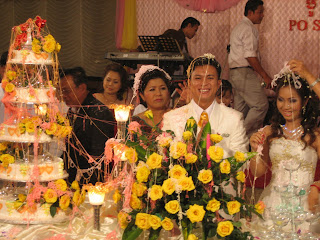 The bride and groom and cake, all covered in pink silly string!
 The groom's friend, a chef at the wedding complex, carrying the Sword of Destiny.
 The Sword of Destiny made one cut into each tier of cake.
 Finally, the bride and groom opened up two bottles of champagne and poured champagne onto the tower of champagne flutes. The champagne overflowed the first glass and trickled down into the flutes below. The flutes were then passed out among the closest family members, a toast was made and the festivities continued.
After these ceremonies, group circle dancing began and lasted for a few more hours.
 Samath and his wife, in their official wedding photo that greeted people as they entered the complex. Note that their wedding is officially sponsored by Heineken :)
 The groom himself, in one of his 4-5 outfits over the course of the evening. He greeted us in a yellow suit, then changed into this red jacket adorned with a giant ruby necklace.
 Dinner is the first event of the evening. That's my new colleague Dana in the foreground. Nicole and Sovatha are chowing down in the background.
 My best Khmer friend Saingyouth (Youth for short) and I are chillin' at dinner. Youth is presenting his best Godfather pose. I just couldn't hold mine.
 Beer was liberally imbibed during and after dinner. Here are some of my colleagues partaking in the post-dinner festivities.
 The official wedding ceremony took place that morning, with only family and close friends in attendance. However, the wedding celebration that evening included some ceremonial activities as well, which took place after dinner. First, the bride and groom walked down a row in between all invitees as we all throw flowers on them.
 After the flowers, the bride and groom circled the center table on which a 5-tiered cake was resting (it was a Cake Walk!--the significance of this will be lost on anyone who did not attend Westival at Lafayette Elementary School) . They circled the table five times, in part because odd numbers represent good luck.
 The bride and groom then stood for a few minutes next to the bride's parents. Check out the Khmer modern-love-ballad band rocking out in the background in front of the pink and red hearts-and-love backdrop!
 After the Cake Walk came the sparklers!
 And after the sparklers came the silly string!
 The bride and groom and cake, all covered in pink silly string!
 The groom's friend, a chef at the wedding complex, carrying the Sword of Destiny.
 The Sword of Destiny made one cut into each tier of cake.
 Finally, the bride and groom opened up two bottles of champagne and poured champagne onto the tower of champagne flutes. The champagne overflowed the first glass and trickled down into the flutes below. The flutes were then passed out among the closest family members, a toast was made and the festivities continued.
After these ceremonies, group circle dancing began and lasted for a few more hours.
Saturday, March 10, 2007
Valentine's Day Festivities
What is a single guy to do on Valentine’s Day in Phnom Penh
The night’s events take place at the Foreign Correspondent’s Club (FCC), a bar and restaurant with a huge amount of history in
I arrive at 7pm, my faux-hawk looking quite sexy. I stand around awkwardly for about 15 minutes before anyone else I know shows up, and then the ball gets rolling. Registration (which, for the bachelors being auctioned, is free), description of the rules and schedule for the evening, acquisition of first and second drinks, etc. And then the Speed Dating begins...
Speed dating consists of men sitting around cocktail tables, engaging in 3 minute conversations with the women who rotate around them. Drinks are free-flowing, and after every date, I write down the name of my date on a piece of paper and then check a box next to their name as either “no interest,” “friend interest,” or “love interest.” A few days after the event, the organizers are to email out the list of people who were correctly matched with me as either a friend or love interest (meaning they also checked the same box, i.e. we were on the same page).
Luckily, nobody takes this event too seriously. I have heard that in the
Halfway through speed-dating, the Charity Bachelor Auction begins. All of the proceeds from the bids are donated to the Starfish Foundation, an NGO doing work locally. Eight of the most eligible bachelors in Phnom Penh are auctioned off, four in this first round, and four after a subsequent round of speed dating. The audience surges as many people, including all of my colleagues, come upstairs just to see us eligible men sell our bodies for charity.
Each man who is called before me (“Come on down!") walks to the stage and looks fairly terrified as their biographies are read and as the bidding begins. Finally, it is my turn, and I walk up and strike a pose. I’m quite terrified as well, and at one point I look into the audience and see my friend Jeni signaling for me to smile. This gesture even surprises me, being the smiley person that I am. Though really, I was just displaying my Blue Steel pose. I swear!

For those who are interested, the official biography of my life until this point is the following:
Lee hails from
Lee attended Brown University in Providence, Rhode Island, the smallest state in the
[A sentence about my work here in
Lee has been in Cirque du Soleil and was once asked to work for a kitchen on a boat in the Galapagos. His pesto has already become famous across
Lee has chatted with Thom Yorke about
Lee enjoys getting hyphy, good trying, Huge in Asia, going to Trader Joe's, Pachamama, volleyball, Piling Rats, kicking SIT Bolivia’s ass for being good at life, Portland, Oregon, pretending to know something about architecture, and Rogue Wave.
Each woman does not just bid on a man to give the proceeds to charity—she receives something out of it in return! Each bachelor has a date lined up. My date, arranged with the help of my friend Lis, consists of a charming drive through smoggy

The bidding starts at $10, and continues in $5 increments up and up and up. A young woman who I don’t know has the high bid for a few seconds, and I am excited. And then Lili, my boss’ wife, outbids her at $40. Lili wins, which is completely hilarious. I exit the stage and present her with a rose and a hug.
[Unfortunately, Lili left a week later, and we were not able to go on our date. This means I currently have free reign over taking someone to my liking J]
The man who takes the highest auction price is Eitan, a 25-year-old Israeli who was able to line up a one-hour airplane flying lesson for his date. Naturally, he goes for $100.
The night continues in revelry and dancing. I am interviewed by the Cambodia Daily, whose reporters excel at investigative journalism—they even participate in speed dating, certainly mixing business with pleasure. Unfortunately, none of my quotes are used in the article, which I will post right here (Thanks Suzy!):
A few had wives or girlfriends-even a telltale wedding ring-but none saw anything wrong with a Valentine's night-out playing the "speed-dating" field at the FCC's rooftop terrace.
Women, clutching glasses of free-flowing wine and beer, moved from table to table every three minutes, and daters ranked their new acquaintances in the margins of a list of names as potential friends or lovers-or neither.
Originally conceived by a Jewish rabbi to ensure that Jewish singles could meet each other in large cities, speed-dating-as it is known-seems to suit the transient, nomadic flux of Phnom Penh's expat population, according to organizers and participants at the FCC.
Attended by 30 men and 30 women, the serial-dating challenge was "a fun way to introduce new people," said FCC head chef Lucia Dengate, adding that the format appeals to people because it is non-committal.
The 60 participants paid $11 at the door, or $9 in advance, to join the event. Most agreed they got their money's worth: a bell rang every 3 minutes to signal that women should move along to their next date.
At the end of the night, daters submitted their forms-with each date's score-to the organizers who will later notify participants of the outcome by e-mail, FCC Group Operations Manager Michelle Duncan said.
Contacted on Thursday, Duncan said that three or four romantic matches were made, but friendship seemed to be the dominant feeling to come out of the night.
It was the second speed-dating night held at the FCC, and was punctuated by a charity "bachelor auction," in which women bid on dates with eight different men.
The auction was the brainchild of two British expatriates, Jeni Dixon and Edward Pollard, after several late-night discussions with friends about "how few single, straight barang guys there are" in Phnom Penh's social circle, Dixon, 27, wrote in an e-mail.
The names of the bachelors for auction were listed on a chalkboard under the heading "Today's Special," and they were cheekily described as a tree hugger, a mama's boy, a proteomic scientist, and a "dark-haired, blue-eyed, long-lashed beauty of a man."
A US Embassy staffer was among the lucky women with winning bids in the auction, which ultimately raised $460 for the Indochina Starfish foundation, a local children's NGO.
Mitchell Isaacs, a 26-year-old bachelor who fetched $55 in the auction, said he was a bit overwhelmed by the attention.
"Who wants to buy me? That's pretty intense," the Australian national said, adding that he was pleased with the price he sold for. "I was expecting, like, $12," he said.
Choup Channa, who observed the teeming crowd of expat daters from a nearby table, thought that speed-dating would be an ideal social event for young, 20-something Cambodians.
"It's a way to be acquainted before being boyfriend-girlfriend," said the 25-year-old Khmer teacher.
"It'd be a good way to meet," she said, "as long as the parents didn't find out."
Two days later, I receive an email with the names of two ladies who are matched as “Love Interests” and three who are matched as “Friend Interests.” That means I was part of about 1/2 of the love matches made that night. Holla!
I definitely went into this whole night thinking I would revel more in how ironic and ridiculous the night would be. But I ended up getting caught up in the excitement and real fun of it all! Really, quite like my experience on The Price is Right, if not quite so flashy.
It's Mango Season, and I'm in Love!

So delicious!
Also, it is Mangosteen season here, which is fabulous news! However, despite its name, this fruit bears no resemblance to mangoes in either appearance or taste.
 According to Wikipedia:
The outer shell of the fruit, its exocarp, is firm (softens during ripening), typically 4-6 cm in diameter, and contains astringent phytochemicals which discourage infestation by insects, fungi, plant viruses and bacteria. The same phytochemicals are pigments giving the exocarp its characteristic purple color, including phenolic acids, also called phenols. These pigments have antioxidant properties which afford the fruit further protection from ultraviolet radiation and free radicals generated during photosynthesis. Isolation of exocarp pigments has permitted their identity to be revealed as xanthones, mainly garcinol and mangostin[1], which, as phenolics, make the exocarp highly astringent and inedible.
Cutting through the shell, one finds edible flesh, botanically defined as an aril, shaped like a peeled tangerine but bright white, about 3-5 cm in diameter, nested in a deep red outer pod. Depending on the fruit size and ripeness, there might be seeds in the aril segments. The seeds, however, are not palatable unless roasted. The number of aril pods is directly related to the number of petals on the bottom of the pericarp. On average, a mangosteen has 5 aril segments (round up figure). The plant does not start producing fruit until around 15 years old, which is somewhat an impediment to cultivation.
The fragrant flesh is sweet and creamy, citrusy with a touch of peach flavor. In Asia, the mangosteen fruit is known as the "Queen of Fruits."Yummy!
Sunday, December 10, 2006
An Evening on the Town
My friend Daniel went crazy after returning from Japan and decided to have a blowout of organized fun one Saturday night.
First, he organized a sunset boat ride on the Mekong, a veritable Phnom Penh tradition. It was something I had been wanting and needing to do, and we made it happen. In fact, in Rough Guide it’s listed as the #1 thing not to miss in Cambodia. You can rent a 100ft long boat for like $20/hour, buy a lot of beer and food, and have a cookout on the boat. I met a lot of Daniel’s expat friends from the past few years, and I feel a lot more connected socially as a result.

Daniel and Deborah on the boat
After flowing down the Tonle Sap river (bordering Phnom Penh), we turned up the Mekong, past nearly-floating villages (tiny wooden shacks floating on the river next to the riverbank), and up to a spot for swimming. At that spot, we watched the sun shrink behind the Phnom Penh horizon in a mélange of pinks and oranges. The owners of the boat boiled about 50 crabs, which looked delicious but which I could sadly not enjoy. I jumped off the roof of the boat into the water, which is questionably sanitary (I had a rash on my leg for a few days afterwards, but no big deal). The river’s current was deceptively strong, but manageable. More than anything, splashing around with new friends in the last light of day on the Mekong River in Cambodia was thoroughly enjoyable. I’m pretty lucky to be here.

On the Boat

A group of Khmer fishing boats on the banks of the Mekong

A floating house, fishing canoes, and small wooden huts on the bank
A short video of the boat ride along the Mekong. I quite like the soundtrack of Neil Young's "Keep on Rockin' In the Free World" in the background. It provides a good summary of the contrasts and internal struggles of working as a foreigner here. Are the people living along the bank and/or on their fishing boats truly free? Certainly we, as foreigners on the boat who work in Cambodia, are operating with a degree of freedom to our actions that is unfathomable for the people living along the bank (and, indeed, for most Cambodians). With a foreigner salary, we can do and access and live in a manner that is quite unattainable for most Cambodians (I am making at least twice as much as the average middle class salary here, on a volunteer stipend!)
We can keep on rockin' freely, but what are we doing here? How beneficial is foreign NGO/IO presence in this country, and especially in Phnom Penh? How do we truly help, and not make our experience here overwhelmingly parasitic or voyeuristic? How much is our presence alleviating the structural impoverishment that these riverbank dwellers face on a daily basis?
These are vital issues that I struggle with and that try to come to terms with. Sometimes this happens by believing in the work I am doing, by hoping that this work is supporting those in need (and I believe it does) and also that it will engender personal growth so that I can better serve others in the future. Of course, sometimes I react through denial, and sometimes by accepting that a certain action is voyeuristic. But these issues are a fine line that we, as foreigners living in Cambodia and in many parts of the developing world, must confront daily--the balance is a tricky one.

Sunset over the Cambodiana Hotel
We returned to Phnom Penh with the lights from the new Naga Casino growing ever closer. After I grabbed a quick bite (being unable to eat the crabs and all), I headed over to see the best (and only) English-language band in Phnom Penh that plays original music. They call themselves Betty Ford and the GT Falcons, and they sound something like Television mixed with the Replacements. A bunch of them are friends with Daniel and were on the boat trip. I’ve become friends with the guitarist Matt, who’s from Australia (as are half of the expats here). In the last week, Matt has taken to calling me “Dynamic Lee,” which I quite enjoy.

Matt and Sean on the Boat

Betty Ford and the GT Falcolns Poster. Even Roger Ebert is a huge fan!
Anyway, the show was pretty surreal because it was at this bar called Zeppelin Café, which is owned by this middle-aged Cambodian who has about 700 LPs from 1972-1979 in the bar—hence the name and theme of the bar. It felt so much like a small bar/music venue in the US that it was quite disorienting. Of course, adding weight to this sentiment was the fact that there were not too many Cambodians at the show besides the bar’s owner (who would’ve thought—Cambodians not digging English rock music). A lot of expats came to the show, and although the sound mixing and acoustics were terrible, we all seemed to have a great time. Watch out, BFAGTF will take the US by storm soon!
First, he organized a sunset boat ride on the Mekong, a veritable Phnom Penh tradition. It was something I had been wanting and needing to do, and we made it happen. In fact, in Rough Guide it’s listed as the #1 thing not to miss in Cambodia. You can rent a 100ft long boat for like $20/hour, buy a lot of beer and food, and have a cookout on the boat. I met a lot of Daniel’s expat friends from the past few years, and I feel a lot more connected socially as a result.

Daniel and Deborah on the boat
After flowing down the Tonle Sap river (bordering Phnom Penh), we turned up the Mekong, past nearly-floating villages (tiny wooden shacks floating on the river next to the riverbank), and up to a spot for swimming. At that spot, we watched the sun shrink behind the Phnom Penh horizon in a mélange of pinks and oranges. The owners of the boat boiled about 50 crabs, which looked delicious but which I could sadly not enjoy. I jumped off the roof of the boat into the water, which is questionably sanitary (I had a rash on my leg for a few days afterwards, but no big deal). The river’s current was deceptively strong, but manageable. More than anything, splashing around with new friends in the last light of day on the Mekong River in Cambodia was thoroughly enjoyable. I’m pretty lucky to be here.

On the Boat

A group of Khmer fishing boats on the banks of the Mekong

A floating house, fishing canoes, and small wooden huts on the bank
A short video of the boat ride along the Mekong. I quite like the soundtrack of Neil Young's "Keep on Rockin' In the Free World" in the background. It provides a good summary of the contrasts and internal struggles of working as a foreigner here. Are the people living along the bank and/or on their fishing boats truly free? Certainly we, as foreigners on the boat who work in Cambodia, are operating with a degree of freedom to our actions that is unfathomable for the people living along the bank (and, indeed, for most Cambodians). With a foreigner salary, we can do and access and live in a manner that is quite unattainable for most Cambodians (I am making at least twice as much as the average middle class salary here, on a volunteer stipend!)
We can keep on rockin' freely, but what are we doing here? How beneficial is foreign NGO/IO presence in this country, and especially in Phnom Penh? How do we truly help, and not make our experience here overwhelmingly parasitic or voyeuristic? How much is our presence alleviating the structural impoverishment that these riverbank dwellers face on a daily basis?
These are vital issues that I struggle with and that try to come to terms with. Sometimes this happens by believing in the work I am doing, by hoping that this work is supporting those in need (and I believe it does) and also that it will engender personal growth so that I can better serve others in the future. Of course, sometimes I react through denial, and sometimes by accepting that a certain action is voyeuristic. But these issues are a fine line that we, as foreigners living in Cambodia and in many parts of the developing world, must confront daily--the balance is a tricky one.

Sunset over the Cambodiana Hotel
We returned to Phnom Penh with the lights from the new Naga Casino growing ever closer. After I grabbed a quick bite (being unable to eat the crabs and all), I headed over to see the best (and only) English-language band in Phnom Penh that plays original music. They call themselves Betty Ford and the GT Falcons, and they sound something like Television mixed with the Replacements. A bunch of them are friends with Daniel and were on the boat trip. I’ve become friends with the guitarist Matt, who’s from Australia (as are half of the expats here). In the last week, Matt has taken to calling me “Dynamic Lee,” which I quite enjoy.

Matt and Sean on the Boat

Betty Ford and the GT Falcolns Poster. Even Roger Ebert is a huge fan!
Anyway, the show was pretty surreal because it was at this bar called Zeppelin Café, which is owned by this middle-aged Cambodian who has about 700 LPs from 1972-1979 in the bar—hence the name and theme of the bar. It felt so much like a small bar/music venue in the US that it was quite disorienting. Of course, adding weight to this sentiment was the fact that there were not too many Cambodians at the show besides the bar’s owner (who would’ve thought—Cambodians not digging English rock music). A lot of expats came to the show, and although the sound mixing and acoustics were terrible, we all seemed to have a great time. Watch out, BFAGTF will take the US by storm soon!
Phnomenally Disabled Volleyball
I met two documentarians from Brooklyn about a month ago (so hip!). They came into my office to film an interview with the director of the National Center for HIV/AIDS, Dr. Vun. He wasn't ready to see them, so they chilled in my office and I talked with them for about a half hour. Their main documentary is about a unique system in Cambodia (also practiced in a few other countries) whereby monks and pagodas are integrated into home-based HIV services (as community health workers) and provide social supports for these people. It makes sense--Buddhism is the oldest institution in most villages, and so utilizing this network has proved quite fruitful.
Anyway, one of the two of them, Scott, was also making a side-project documentary about the Disabled Volleyball League of Cambodia, which is apparently the best-run and least-corrupt sports league in Cambodia. There was a tournament the next day, so I met Scott at the court and I watched 3 matches.

These players are INCREDIBLE!
So how disabled are they? Some of them only had minor restrictions in their movement caused by polio or having been shot in the arm, but about 70% were landmine victims who had missing limbs or hands. The best disabled-volleyball spiker in the world was there, and he plays barefoot and is missing his right forearm. His ability is even more exceptional because, like in many countries, all Cambodians are taught to be right-handed. So he essentially had to learn to play volleyball, or re-learn how to play, in a counter-intuitive manner. A left handed spiker in Cambodia is a truly remarkable feat!


Below, the best spiker wins the point!
The whole day was pretty incredible and inspirational, and I was so surprised by the high level of play. Apparently Phnom Penh is hosting the world cup of Disabled Volleyball in Dec 2007--I won't be here. It's cool the things you learn that you never knew existed!
Last weekend, I was able to break away from my Clinton trip-planning duties to watch the championships in the one indoor court in all of Cambodia, at the Olympic Stadium in Phnom Penh. The Phnom Penh Sunway Dragons beat the Siem Reap DHL Eagles 25-15, 25-20, 25-17 (not absolutely certain about the score in that last set, but I think it's correct). It was a really exciting game, and the left-handed spiker for the Dragons (about whom I wrote above) definitely dominated with spikes and blocks.
The stadium, with a capacity of 2000 or so, was about a quarter filled. Despite the feeling of emptiness, the game generated a lot of excitement among those who were there, with people cheering shouting, clapping for good points. There were about 20 foreigners there, a lot of Cambodians, about 7-8 of the other teams in the league (I sat behind them for one set and it was like sitting in an enclosed smoking section—for athletes, those guys smoke a lot of cigarettes!). What was strange was that there were so many more Siem Reap fans, despite the game being in Phnom Penh. And the Siem Reap sponsors came out in droves—there were about 20 Cambodian DHL workers dressed in their daily uniforms cheering for their team! The Siem Reap fans were definitely the most vocal, shouting “SIEM REAP” every time they scored a point.
One other strange thing was the VIP section in the stands. Granted, it was the championships, and the His Excellency ……., the Minister of Social, Veterans and Youth Affairs (MoSVY) was in attendance. But I thought the Cambodian waiters dressed in tuxes serving soda, water, and hors d’ouvres was a bit overboard. I guess it is not so strange, considering the amount of corruption in most levels of government in this country, and considering that they wanted to show off at the Championship game, but I was certainly surprised.
But seriously, I haven’t seen that level of skill and intensity in a volleyball match in a long time (sorry if I offend any of my Team from the Block/Fellowship of the Bling team members with this statement).
You can check out a clip of Scott's footage here. Also, look at his "Hunting Dumplings" post--I ate lunch at this place with my Cambodian coworker Saingyouth last week and it was incredible!!!
Hell yeah, volleyball!
Anyway, one of the two of them, Scott, was also making a side-project documentary about the Disabled Volleyball League of Cambodia, which is apparently the best-run and least-corrupt sports league in Cambodia. There was a tournament the next day, so I met Scott at the court and I watched 3 matches.

These players are INCREDIBLE!
So how disabled are they? Some of them only had minor restrictions in their movement caused by polio or having been shot in the arm, but about 70% were landmine victims who had missing limbs or hands. The best disabled-volleyball spiker in the world was there, and he plays barefoot and is missing his right forearm. His ability is even more exceptional because, like in many countries, all Cambodians are taught to be right-handed. So he essentially had to learn to play volleyball, or re-learn how to play, in a counter-intuitive manner. A left handed spiker in Cambodia is a truly remarkable feat!


Below, the best spiker wins the point!
The whole day was pretty incredible and inspirational, and I was so surprised by the high level of play. Apparently Phnom Penh is hosting the world cup of Disabled Volleyball in Dec 2007--I won't be here. It's cool the things you learn that you never knew existed!
Last weekend, I was able to break away from my Clinton trip-planning duties to watch the championships in the one indoor court in all of Cambodia, at the Olympic Stadium in Phnom Penh. The Phnom Penh Sunway Dragons beat the Siem Reap DHL Eagles 25-15, 25-20, 25-17 (not absolutely certain about the score in that last set, but I think it's correct). It was a really exciting game, and the left-handed spiker for the Dragons (about whom I wrote above) definitely dominated with spikes and blocks.
The stadium, with a capacity of 2000 or so, was about a quarter filled. Despite the feeling of emptiness, the game generated a lot of excitement among those who were there, with people cheering shouting, clapping for good points. There were about 20 foreigners there, a lot of Cambodians, about 7-8 of the other teams in the league (I sat behind them for one set and it was like sitting in an enclosed smoking section—for athletes, those guys smoke a lot of cigarettes!). What was strange was that there were so many more Siem Reap fans, despite the game being in Phnom Penh. And the Siem Reap sponsors came out in droves—there were about 20 Cambodian DHL workers dressed in their daily uniforms cheering for their team! The Siem Reap fans were definitely the most vocal, shouting “SIEM REAP” every time they scored a point.
One other strange thing was the VIP section in the stands. Granted, it was the championships, and the His Excellency ……., the Minister of Social, Veterans and Youth Affairs (MoSVY) was in attendance. But I thought the Cambodian waiters dressed in tuxes serving soda, water, and hors d’ouvres was a bit overboard. I guess it is not so strange, considering the amount of corruption in most levels of government in this country, and considering that they wanted to show off at the Championship game, but I was certainly surprised.
But seriously, I haven’t seen that level of skill and intensity in a volleyball match in a long time (sorry if I offend any of my Team from the Block/Fellowship of the Bling team members with this statement).
You can check out a clip of Scott's footage here. Also, look at his "Hunting Dumplings" post--I ate lunch at this place with my Cambodian coworker Saingyouth last week and it was incredible!!!
Hell yeah, volleyball!
Saturday, November 11, 2006
Water Festival Video
Look how tech savvy I am! I shot this video from the Riverfront on the last day of races.
Settling In
Finally, I’m starting to feel somewhat comfortable here in
I've had a good week, and feel better about living here, for 3 reasons:
1. Water Festival this past weekend:
2. Meeting great people. I met up with this guy Yazan. We were told to meet because he is a friend of a friend of Hannah Lantos. He just graduated from Duke, was actually their student Graduation Speaker, and is currently working with an NGO that runs an orphanage in Battambang. He's working on an ongoing Duke research project and is funded as a sort of 1-year post-bac fellowship. Battambang is 6 hours away, but he was here for Water Festival. It was so wonderful talking with someone my own age, going through similar changes at the same stage of life (adjusting to life after college). Everyone else here is at least 27, and while many are awesome, few are going through that one particular and difficult change. Also, he has been here 3 months, so it's inspiring to see how well he as adapted Cambodian life and how well he's learned Khmer. Something to strive for.
It was great to have such flowing and interesting conversations with someone who I could relate to so well. I hope there are others out here who aren't 6 hours away too.
On Wed night, Daniel invited me to dinner at his friends’ apartment, a beautiful, open space with great art on the walls, an atrium, and a spectacular balcony. Man, if only the French had stayed in power here, everybody would have apartments like this! Well, at least the wealthy, and then the underbelly of society would work for them, but at least they would be working in beautiful buildings. Please note the sarcasm in these statements; otherwise it would sound really insensitive.
Anyway, I had a great night of amazing food and conversation with 8 of Daniel’s friends here. They are all older, but are really fun and interesting, 2/3 of them work for NGOs, predominantly with orgs that combine the arts with the empowerment of children, or with environmental orgs. The others worked for the UN (UNICEF, UNHCR). Really fun, interesting, smart, and motivated people—hopefully I will see them increasingly in the coming months.
3. I decided to take a day trip out of
There was also one mosque at the top of one of the outer hills. It had been there for 50 years, though it had also been gutted during the Khmer Rouge. Along the drive, I also saw about 4 mosques—Islam is the second-most practiced religion here, and has a growing presence. I want to find out more about Muslim culture and how it interacts with Buddhist culture here. The
At Oudong, there were so many beggars--amputees, the blind, the aged, children, it was very overwhelming, and there was one for about every 5 steps on the 509 steps on the staircase up the hill. One shrewd teenager came up to me and started fanning me, and then followed me and Sophorn the whole way. We couldn’t get rid of him, but the fanning was pleasant, even if I felt a little strange being so lavished with privilege. I gave him two dollars at the end, and all along the way gave some of the beggars—and all of the amputees—about a quarter each. There are money changers who change larger bills for the smallest currency so that people can distribute small amounts to more people, and to the Buddhist offering sites, along the whole route. But all in all, just seeing the way houses were constructed, the way people were living, and the forms of spiritually displayed at these important sites was very interesting, beautiful, and a refreshing change of pace to the chaos of Phnom Penh.
Monday, November 06, 2006
A Few Photos
You may click on these photos to enlarge them. ENJOY!
 Independence Monument, only 4 blocks from my apartment. It commemorates independence from the French in 1953. At night it's quite beautiful, floodlit in red, white, and blue lights, the primary colors of the Cambodian national flag.
 A street in Phnom Penh demonstrating disparities. Note the seemingly burned-out row houses in the back, with people living in every room possible. Contrast this with the Toyota Minivan in the foreground, with "Donated By" painted on its side. It was probably donated by a foreign NGO. Local and foreign welath shows its presence here and is a stark contrast to the deep poverty in which most Cambodians are immersed.
 A view of the National Assembly. It is a truly beautiful piece of Khmer architecture (sorry for the tree obscuring the view!). My landlord works here (as a clerk, not as an assemblymen). His house and possessions speak to the utter corruption of the goverment--the family owns a Lexus SUV and many expensive house decorations and antiques.

 Small fishing canoes coming in to dock on the banks of the Tonle Sap. The Tonle Sap and Mekong Rivers converge at the center (north-south meaurement) of Phnom Penh and form the eastern border of the city. The Riverfront area, which has been developed as a grassy boulevard with trees and shrines along the river, and with restaurants, bars, and hotels across the street, is located just north of the convergence--right on the Tonle Sap. Many of the owners of these small boats eat, sleep, and live on them, even families of 4 or 5.
 This is a great shot of the Riverfront Area, Sisowath Quay. The elephant's name is Sam Bo. He leads an interesting existence. During the day, he is tied up at the base of Wat Phnom, a park that consists of a hill (the only hill in Phnom Penh) with a pagoda on top. He gives rides, eats bananas, and poses for photos all day while being tied up most of the time. Then, at rush hour, he is led on a walk through rushhour traffic down Sisowath Quay to his home. I think his home is behind the restaurant La Croissette, or maybe he just wears their banner (the red cloth on his back and sides) as advertisement for fun!
 Sam Bo crossing the street.
 A morning view from the apartment I lived in for 1 day. The view was what sold me on the place. I moved out because I felt uncomfortable, because the floor was slanted, because it was up 5 flights of stairs, and because I thought there were bugs crawling all over me in bed the night I stayed there! Don't worry, I'm not totally insane, and I'm happy where I am now. The Khmer architecture in the foreground is a pagoda, and the Japanese (Friendship) Bridge is in the background.
 A balcony view of an alleyway and typical housing in Phnom Penh.
 In the foreground is an outdoor concert space. It serves as a parking lot most of the week, but performances and concerts take place in the early evening on Saturdays and Sundays. In the background, the bell-like structure is Wat Phnom.
 The speaking panel at the Convocation Meeting for the Review of the 2006 Work Plan and the Revision of NCHADS's 2007 Work Plan. It was a two-hour long, painfully boring ceremony--even though translation was not simultaneous (it was made after each statement or group of statements), they turned down the microphones on those speaking English so that the Khmer in the audience would focus more on the Khmer translation. I cannot understand the Khmer, and could barely hear the English.
From left, Nicole Seguy, WHO who works at NCHADS; Dr. Mean-Chhi Vun, Director of NCHADS; Lizzie Smith, the head of health programs in Cambodia for DFID, the British Gov's development agency; Dr. Mambun Heng, Secretary of State for Health; Jonathan Ross, Director of health programs for USAID in Cambodia; Tony Lisle, Country Director for UNAIDS; and a man from the CDC.
 A celebration for the grand opening of a guesthouse. This is on a street about 2.5 blocks from my apartment now. Similar tents are set up for many occasions--grand openings, weddings, and celebrations to gather offerings and donations for pagodas. They block off half of or whole streets, depending on the number of guests invited. All are colorful, with ornate and bright decorations, flowers, ribbons, and food.
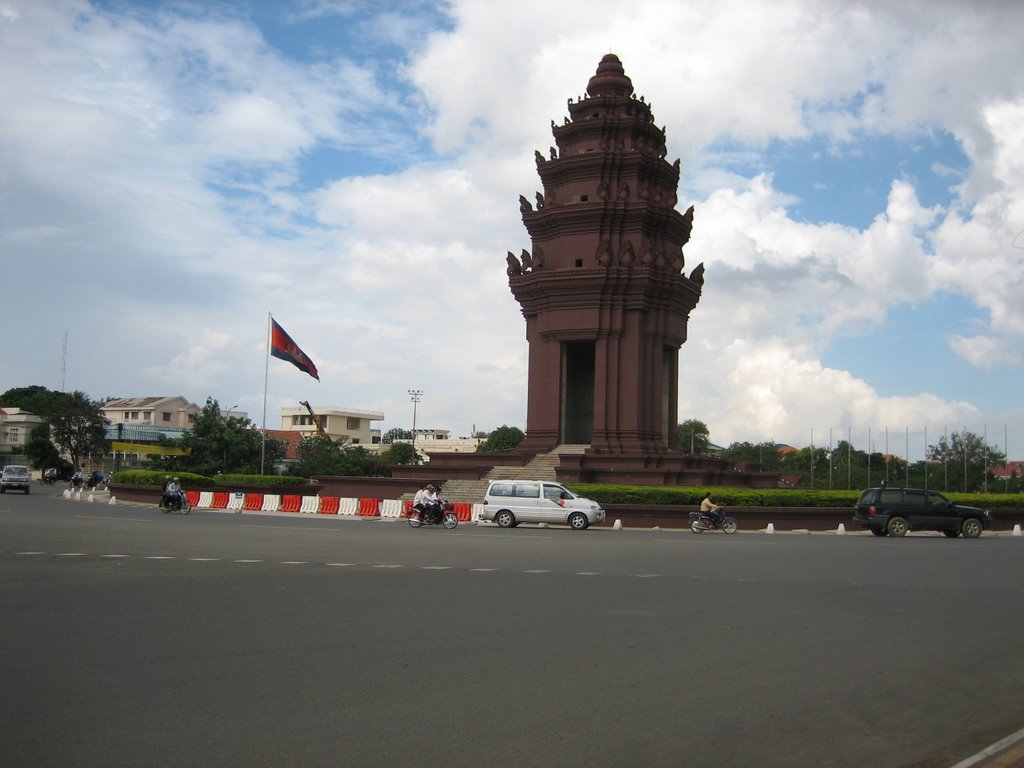 Independence Monument, only 4 blocks from my apartment. It commemorates independence from the French in 1953. At night it's quite beautiful, floodlit in red, white, and blue lights, the primary colors of the Cambodian national flag.
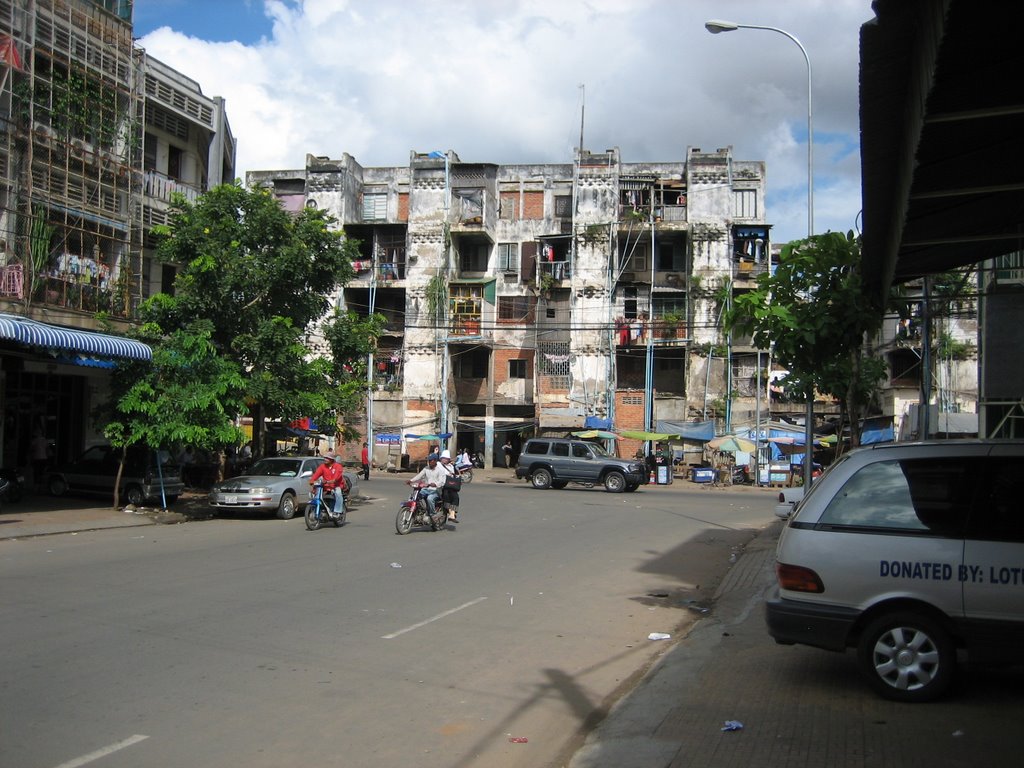 A street in Phnom Penh demonstrating disparities. Note the seemingly burned-out row houses in the back, with people living in every room possible. Contrast this with the Toyota Minivan in the foreground, with "Donated By" painted on its side. It was probably donated by a foreign NGO. Local and foreign welath shows its presence here and is a stark contrast to the deep poverty in which most Cambodians are immersed.
 A view of the National Assembly. It is a truly beautiful piece of Khmer architecture (sorry for the tree obscuring the view!). My landlord works here (as a clerk, not as an assemblymen). His house and possessions speak to the utter corruption of the goverment--the family owns a Lexus SUV and many expensive house decorations and antiques.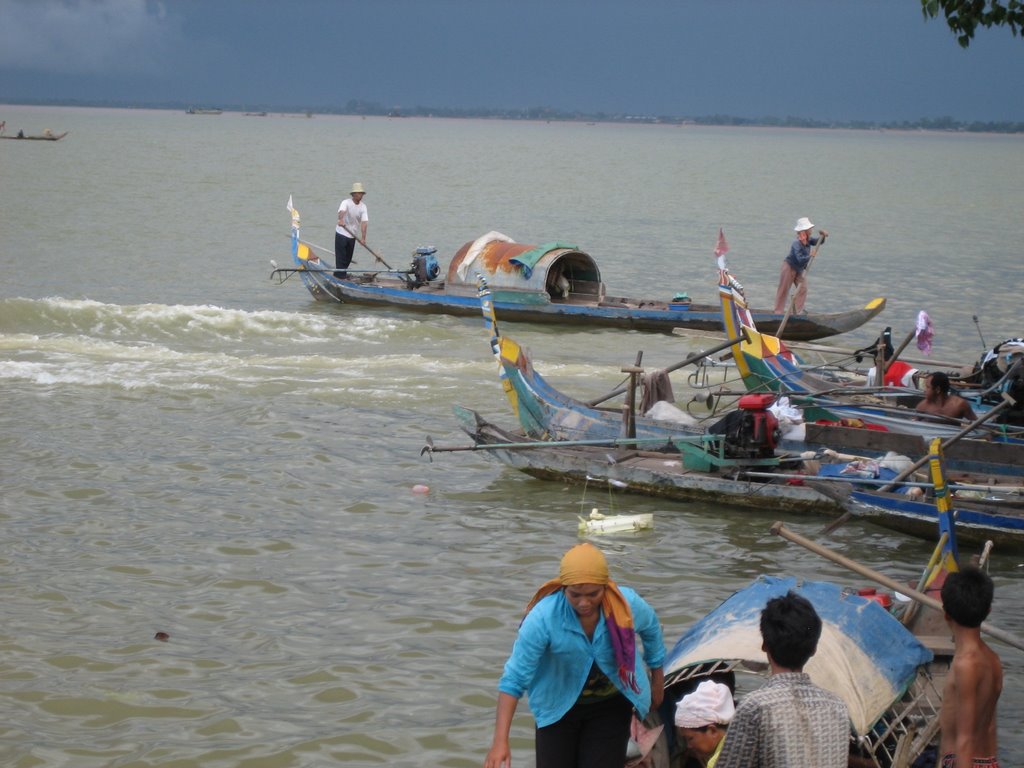
 Small fishing canoes coming in to dock on the banks of the Tonle Sap. The Tonle Sap and Mekong Rivers converge at the center (north-south meaurement) of Phnom Penh and form the eastern border of the city. The Riverfront area, which has been developed as a grassy boulevard with trees and shrines along the river, and with restaurants, bars, and hotels across the street, is located just north of the convergence--right on the Tonle Sap. Many of the owners of these small boats eat, sleep, and live on them, even families of 4 or 5.
 This is a great shot of the Riverfront Area, Sisowath Quay. The elephant's name is Sam Bo. He leads an interesting existence. During the day, he is tied up at the base of Wat Phnom, a park that consists of a hill (the only hill in Phnom Penh) with a pagoda on top. He gives rides, eats bananas, and poses for photos all day while being tied up most of the time. Then, at rush hour, he is led on a walk through rushhour traffic down Sisowath Quay to his home. I think his home is behind the restaurant La Croissette, or maybe he just wears their banner (the red cloth on his back and sides) as advertisement for fun!
 Sam Bo crossing the street.
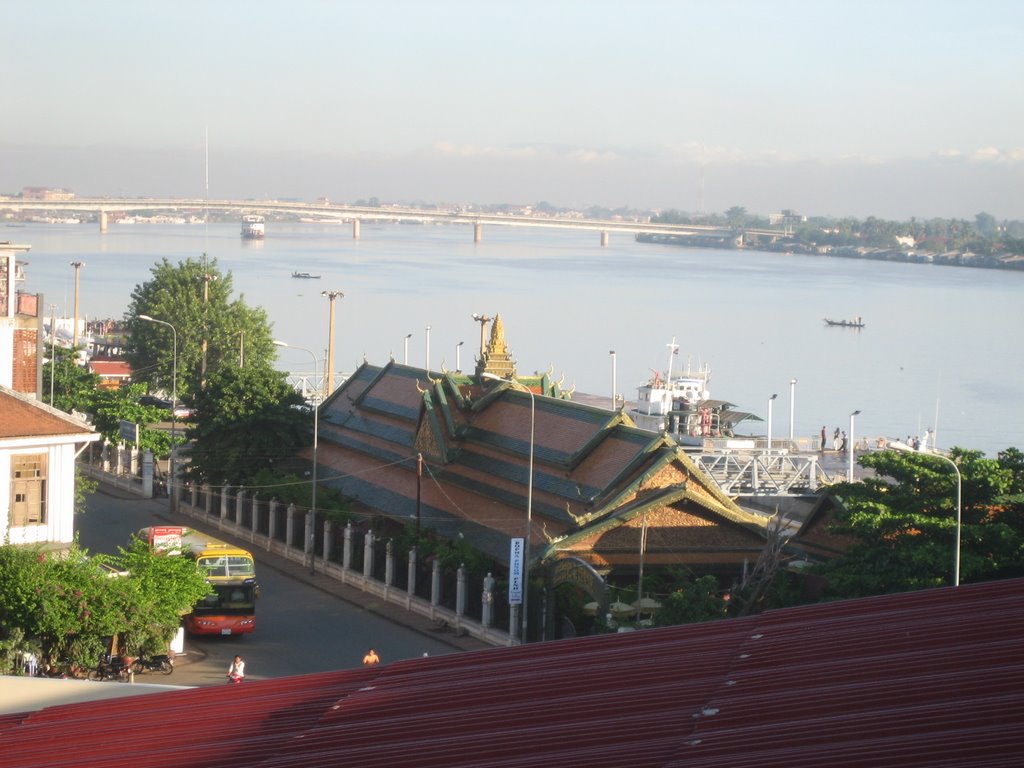 A morning view from the apartment I lived in for 1 day. The view was what sold me on the place. I moved out because I felt uncomfortable, because the floor was slanted, because it was up 5 flights of stairs, and because I thought there were bugs crawling all over me in bed the night I stayed there! Don't worry, I'm not totally insane, and I'm happy where I am now. The Khmer architecture in the foreground is a pagoda, and the Japanese (Friendship) Bridge is in the background.
 A balcony view of an alleyway and typical housing in Phnom Penh.
 In the foreground is an outdoor concert space. It serves as a parking lot most of the week, but performances and concerts take place in the early evening on Saturdays and Sundays. In the background, the bell-like structure is Wat Phnom.
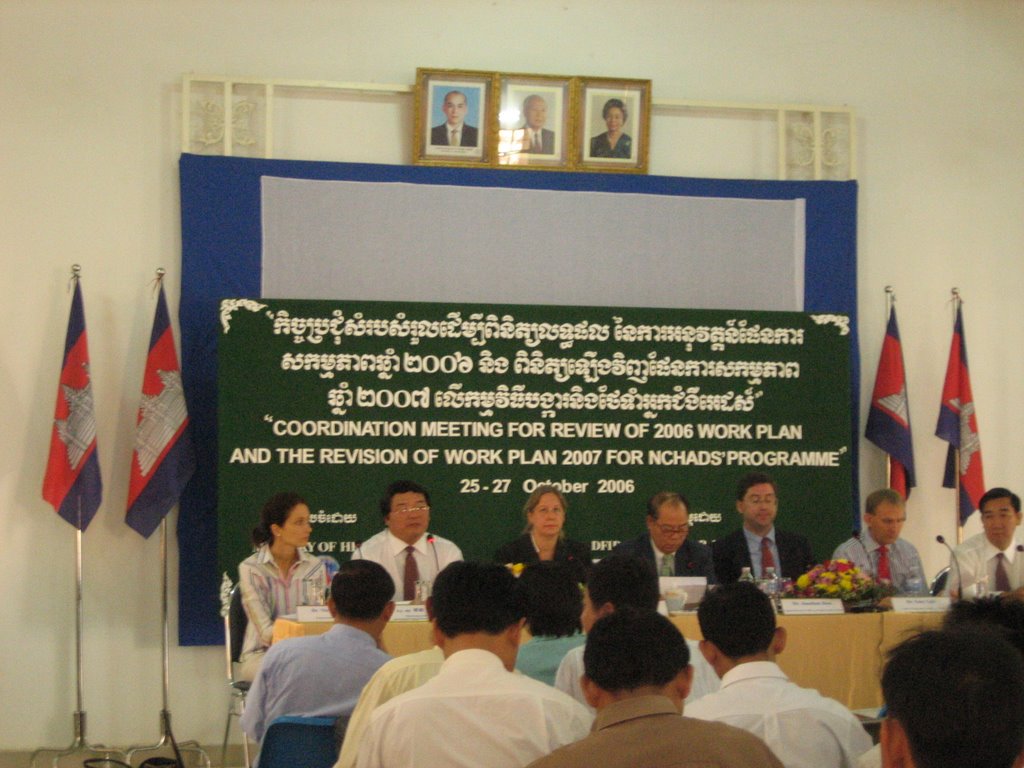 The speaking panel at the Convocation Meeting for the Review of the 2006 Work Plan and the Revision of NCHADS's 2007 Work Plan. It was a two-hour long, painfully boring ceremony--even though translation was not simultaneous (it was made after each statement or group of statements), they turned down the microphones on those speaking English so that the Khmer in the audience would focus more on the Khmer translation. I cannot understand the Khmer, and could barely hear the English.
From left, Nicole Seguy, WHO who works at NCHADS; Dr. Mean-Chhi Vun, Director of NCHADS; Lizzie Smith, the head of health programs in Cambodia for DFID, the British Gov's development agency; Dr. Mambun Heng, Secretary of State for Health; Jonathan Ross, Director of health programs for USAID in Cambodia; Tony Lisle, Country Director for UNAIDS; and a man from the CDC.
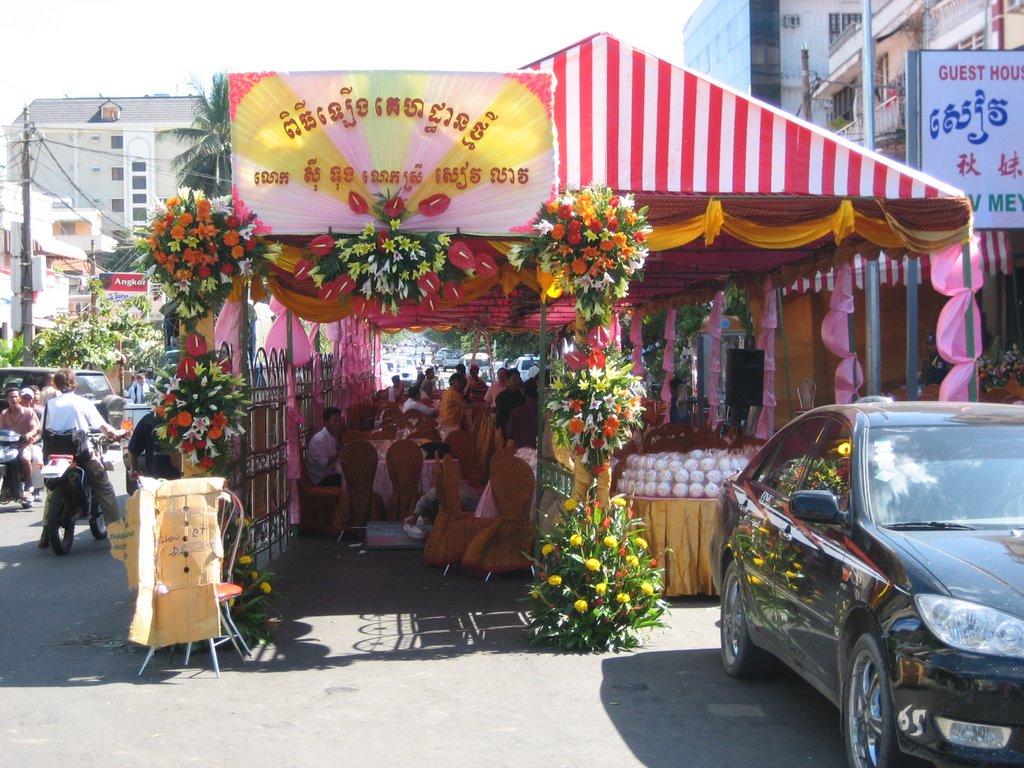 A celebration for the grand opening of a guesthouse. This is on a street about 2.5 blocks from my apartment now. Similar tents are set up for many occasions--grand openings, weddings, and celebrations to gather offerings and donations for pagodas. They block off half of or whole streets, depending on the number of guests invited. All are colorful, with ornate and bright decorations, flowers, ribbons, and food.
Subscribe to:
Posts (Atom)
